


My Honest SNOO Review as a Sleep Consultant (and Mom)
Why I Decided to Try the SNOO
As a pediatric sleep consultant, mom and family nurse practitioner, I talk with many families about sleep and what to expect in the newborn period. The biggest thing my background has taught me? That newborn sleep is developmentally unpredictable, that frequent wake-ups are normal and expected, and that it is an overwhelming season.
As a sleep consultant, I spend a lot of time telling parents that there is no magic sleep product or trick. So naturally, when I had my own baby, I was very curious about the SNOO and whether it would make the early months any easier.
With my first baby, we used a bedside bassinet and experienced all the normal newborn sleep challenges. With my second, I decided to find a secondhand SNOO on Facebook Marketplace and wanted to share my experience as a mom and my honest review as a sleep consultant. Keep reading to see my honest review of the SNOO as a sleep consultant and mom.
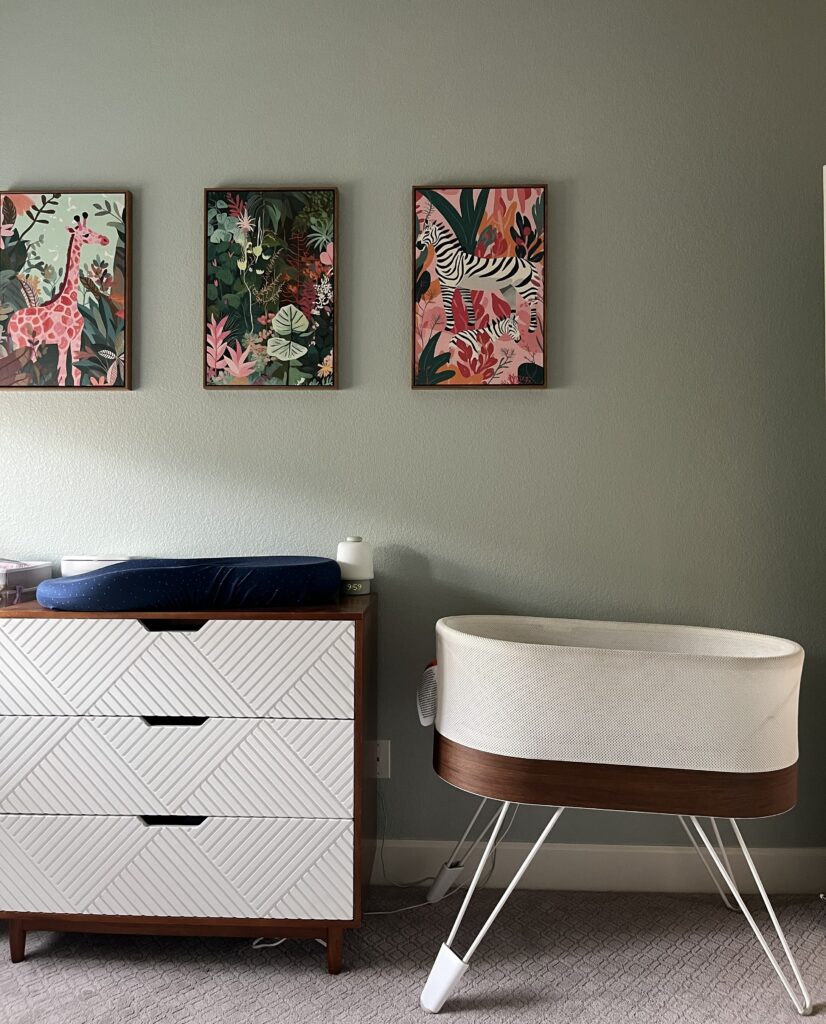
What is the SNOO?
The SNOO is a smart bassinet that includes rocking, white noise, a swaddling system, and escalating responses to fussing or crying. It is designed by pediatrician Dr. Harvey Karp (author of The Happiest Baby on the Block). It is designed for use from birth up to about 6 months of age, or until the baby can push up on their hands and knees.
The bassinet uses continuous gentle side to side rocking and white noise. Built-in microphones detect when the baby begins fussing or crying. If fussing or crying is detected, it automatically escalates through four levels of faster rocking and louder white noise to calm the baby, returning to a baseline level once the baby settles. If after 5 minutes of escalated noise and motion your baby doesn’t settle, it turns off and alerts you. You have to use a special swaddle that clips in which allows the smart bassinet to turn on and prevents the baby from rolling over.
Brand new a SNOO costs $1,995 but they are easy to find in the secondhand market for much cheaper. There is an app that controls the SNOO and offers additional control of settings including the volume of white noise, how responsive it is, and limiting the motion.
Our Experience With the SNOO
We purchased and began using the SNOO once our baby was 4 weeks old. This was perfect for us. She had been steadily gaining weight and was well past birth weight, and we had begun to understand her cues and needs.
The first few weeks (4-6 weeks old)
Before we began using the SNOO, our baby’s longest stretch of sleep was 3 hours at the start of the night and then she would wake up to feed every 90 minutes – 3 hours the rest of the night. The first two weeks of using the SNOO overnight, her sleep stretches lengthened – typically 4-5 hours to start the night and then 3-4 hour chunks of sleep the rest of the night. Using the SNOO didn’t mean my baby magically stopped waking. Like any newborn she still needed to be fed, diapered and comforted overnight.
We noticed right away the difference in her sleep with the gentle rocking and white noise. The longer sleep stretches immediately upon using the SNOO made it clear that it was helping us all get more sleep.
How we used the SNOO
Because she was so little still and we wanted to remain responsive, we never allowed the SNOO to escalate and increase the volume of white noise or the speed of the rocking. We attended to her right away for the first several weeks when she cried – we changed her diaper and fed her as needed.
The SNOO wasn’t helpful for us in getting her to fall asleep. For several weeks, we rocked and fed her to sleep at bedtime and in the middle of the night before setting her in the bassinet. Our goal was longer stretches of sleep, not for it to put her to sleep for us or to delay responding to her fussiness or cries.
We did “double swaddle” her from the beginning. The SNOO comes with its own swaddle that must be clipped in for it to turn on. It is challenging to get this clipped and unclipped with a baby zipped inside. It worked really well for us to swaddle her separately using the Love To Dream swaddle and just zip her in the SNOO swaddle when we transferred her.
6-8 weeks of age
During this time many newborns go through changes that make sleep more challenging – they have a harder time settling, need more socking/bouncing/shushing, and will no longer sleep any and everywhere.
This is where the SNOO really started to make a big difference for us. She was consistently waking up once or twice per night to feed. After she was fed, if she was still awake, she was content to be set down in the bassinet while it gently rocked her to sleep. If your baby likes to “party” in the middle of the night, you’ll know how helpful this is. Instead of having to rock and hold the baby until they’re asleep again, you can set them down in a safe sleep space and fall back asleep yourself.
So, did the SNOO actually help?
Yes! By 9 weeks old, she was waking up just once per night. I believe it was the gentle rocking motion and white noise that made a difference in getting us longer sleep stretches at this age. We never allowed or wanted the escalated rocking or white noise for two reasons. First, we wanted to remain responsive to her needs and didn’t want the bassinet to quiet her communication about needing food, a diaper, or comfort. And second, I knew this would make her transition to the crib easier. It is a tool and we used it as such.
But, I will say that maybe we also got lucky with a good sleeper. Also, it’s very possible we could have arrived here (one wake up per night) without the SNOO. I know from my sleep consultant background that it’s possible to set an early foundation of healthy sleep habits that support longer stretches of sleep.
Weeks 9+ and transition to the crib
From 9 weeks of age until 4 months old, she woke up once per night and quickly fell back asleep after being fed. This whole period we left it on baseline mode. Around 3 months old, when she showed signs of rolling, we transitioned her out of her Love To Dream swaddle and put her hands out in the Snoo swaddle (more on the SNOO swaddle below). She started sleeping through the night on her own around 4 months of age. At this point, we turned off the motion and allowed the white noise to continue.
Around 5 months old, we began seeing signs that she was ready for more space so we transitioned her to the crib. She transitioned flawlessly to the crib.
What I Loved About the SNOO:
- The white noise + motion combination was effective for our baby.
- The swaddle system gave me peace of mind.
- It was especially helpful during the hardest newborn weeks. When my husband returned to work, it was so nice having a tool to get longer stretches of sleep and help her fall back asleep more quickly after feeding.
- It helped with setting her down for naps in the early days. Most newborns love contact naps. That was certainly true for both of my babies! For naps, I found she was more likely to stay asleep when transferring to the SNOO compared to the crib. She definitely slept longer too.
What I Didn’t Love:
- It Is Expensive – The price tag for a new SNOO makes it a luxury item. It might be worth buying new if you plan to use it for multiple children or if there’s a strong resale market in your area. For us, buying it secondhand was perfect. In my area, used SNOOs sell for $400-$800. We plan to sell ours now that we’re done and recoup some of the money. There is a rental option as well from the manufacturer.
- It Doesn’t Replace Responsive Parenting – A smart bassinet is a tool – not a replacement for responding to your baby. We still picked up our baby, fed her, and rocked her when she needed us.
- The SNOO swaddle – It must be clipped into the bassinet in order for it to work which is a safety feature. I found it nearly impossible to clip it in with the baby already zipped inside the swaddle. Our solution was to leave the SNOO swaddle clipped in, swaddle with our preferred newborn swaddle, and then place her into the SNOO swaddle already asleep and zip her up.
- It Didn’t Make My Baby Sleep Through the Night – Newborns still wake up to eat and normal newborn sleep is fragmented with frequent wake ups. A bassinet cannot and should not override a baby’s needs.
- The white noise and motion can escalate too much – We always kept our bassinet at the baseline level for noise and motion. Anything above baseline, especially the motion, upset our baby more. The jiggling and rocking motion was quite intense at the highest level. Fortunately with the app you can control these settings.
The SNOO From a Sleep Consultant’s Perspective
The SNOO has somewhat of a poor reputation in the sleep consultant world. Many sleep consultants rather see parents focus on sleep shaping rather than use a responsive bassinet. Sleep shaping is a gentle, responsive approach used for newborns and young infants (typically from birth to 4 or 5 months old) to establish healthy sleep habits and set the foundation for independent sleep before formal sleep training is developmentally appropriate
As a mom who’s been in the thick of the newborn trenches and sleep deprivation twice, I didn’t personally have the bandwidth to worry about setting a foundation for independent sleep habits in the first 3 months. I was in survival mode and was willing to maximize our sleep in a way that was responsive and safe. For me that has meant feeding and rocking my baby to sleep plus using the SNOO as a tool to support longer sleep stretches.
So yes, if you have the support or strong desire, I think sleep shaping is wonderful. I teach families about sleep shaping all the time. It’s a slow burn; it takes lots of consistent practice for the long-term payoff of your baby falling asleep independently by 3-4 months of age. But, it is not practical for most families.
The other challenge I’ve seen as a sleep consultant, but didn’t experience with my own baby, is that some babies really struggle to transition to the crib when they’ve grown accustomed to the gentle rocking of the SNOO. However, this is really no different from the motion most babies need to fall asleep – rocking, bouncing, etc – it’s just not a parent providing that motion/assistance. Whether it’s a parent doing the rocking or the SNOO, some babies will need extra assistance or sleep training to transition to the crib.
So as a sleep consultant, if you want to use a SNOO, I say go for it! It was a huge help to our family, and our baby is a great sleeper now. I’ve helped numerous families who used a SNOO with their newborn and now have babies and toddlers who sleep beautifully.
Does the SNOO “Teach” Independent Sleep?
No, but I don’t see that as the goal of the SNOO. Newborns aren’t expected to independently put themselves to sleep. Motion and assistance to fall asleep are developmentally appropriate. Using a sleep-supportive product doesn’t mean you’re creating a bad habit. Independent sleep skills develop over time. When you’re done with the SNOO, you can teach your baby independent sleep skills if necessary.
Is the SNOO Necessary?
No, it’s not necessary but that doesn’t mean it’s not useful. I know from reading lots of reviews and talking to families I work with that it is a helpful tool for most. However, not every baby is going to respond well and sleep better.
I would use the SNOO again – but I don’t think every family needs one.
Who I Think Would Benefit Most From a SNOO
I would especially consider it if:
- You really value convenience during the newborn stage.
- Your baby responds well to motion.
- You have the budget for it.
- You’re looking for another soothing tool.
- You anticipate wanting help with settling during those exhausting early weeks.
I wouldn’t feel like you need one if:
- It’s outside your budget.
- Your baby sleeps well in a traditional bassinet.
- You don’t want to rely on motion.
- You prefer a minimalist approach to baby gear.
Final Takeaway
The SNOO didn’t make my baby sleep through the night. That was never the goal and is not a realistic expectation. What it did give me was another tool for soothing my baby during a very demanding stage of parenthood.
There is no single “right” way to do newborn sleep.
Some babies love motion and some don’t. Some parents love contact naps. Others desperately need a place to put their baby down. A SNOO can be helpful, but it isn’t a prerequisite for getting longer stretches of sleep in those early days.
What questions do you have about the SNOO? If you used it, what was your experience?

